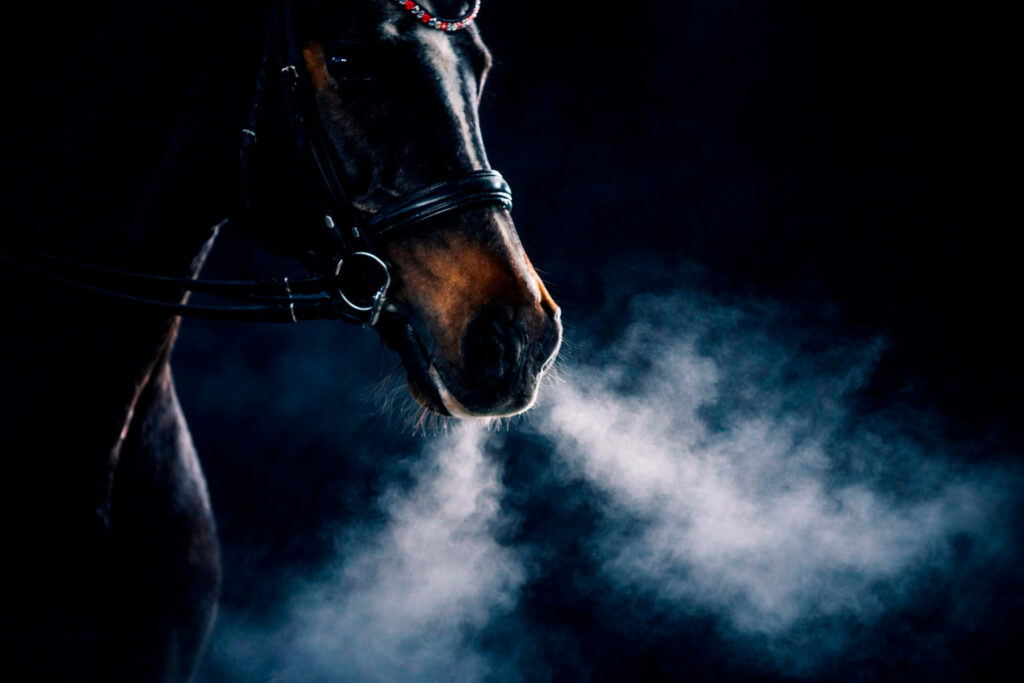
Respiratory Noise
Performance Loss in Horses
Dynamic Laryngoscopy
Overground Endoscopy
What is it?
Examination of the upper airways during actual exercise under the rider,
allowing functional abnormalities to be identified that are often not visible during resting examinations.
When is this examination indicated?
- respiratory noise during riding or exercise
- unexplained performance loss during training
- suspected laryngeal disorders (e.g. laryngeal hemiplegia)
- problems occurring only during work, not at rest
Your benefit
- realistic diagnosis under true training conditions
- mobile service throughout Germany
- immediate assessment by a specialised equine surgeon
Respiratory Noise and Performance Loss in Horses – Overground Endoscopy
Respiratory noise during riding?
Loss of performance despite regular training?
Normal findings at rest?
Many disorders of the upper airways occur exclusively during exercise.
Exactly where athletic performance is required – in motion – these problems often remain undetected during conventional examinations.
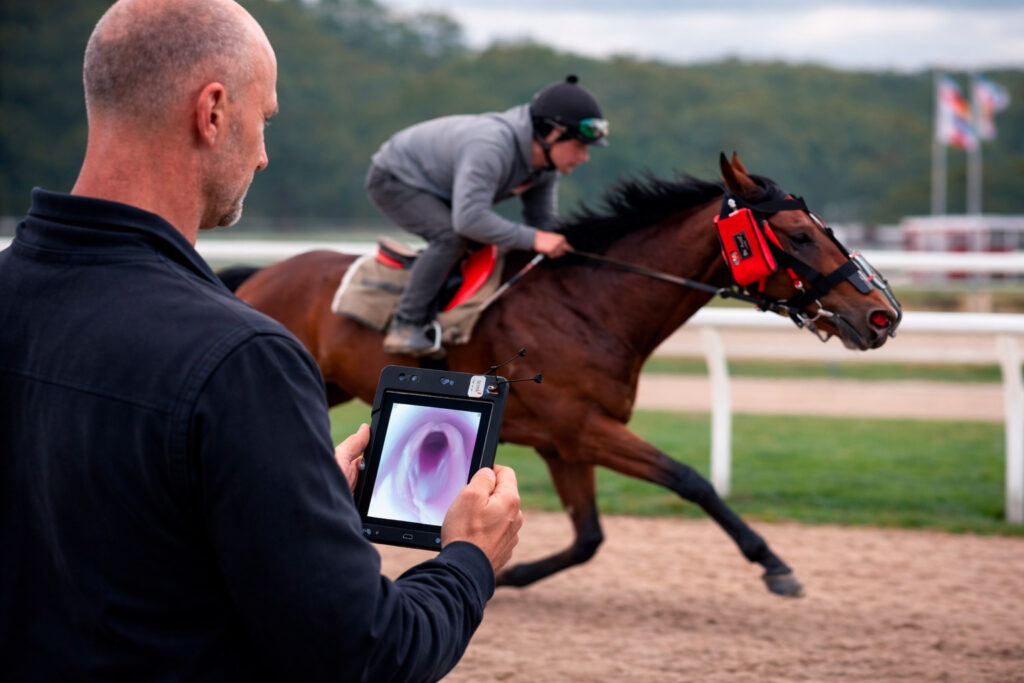
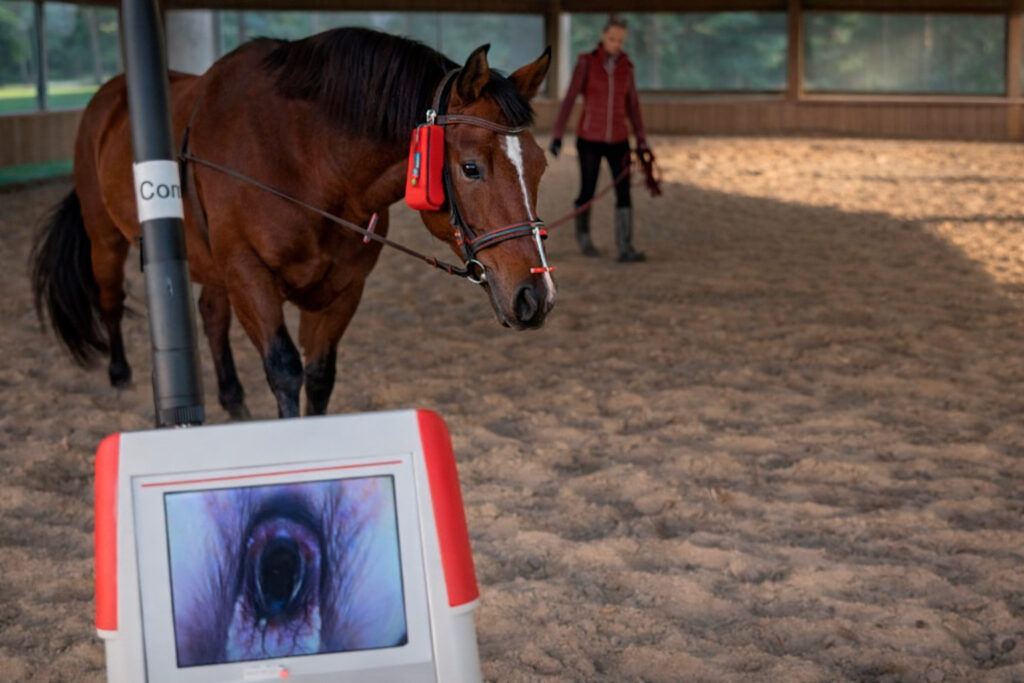
Overground endoscopy (dynamic laryngoscopy) allows evaluation of the upper airways while the horse is actually working, under real training conditions.
Seeing what really happens – while the horse is exercising
Many functional upper airway disorders do not appear at rest, but only when:
- airflow increases
- inspiratory negative pressure rises
- muscular tension builds up
- head–neck position and workload change
At rest, the horse often appears completely normal – yet during exercise the following may develop:
- respiratory noise
- performance loss
- early fatigue
- instability under workload
Overground endoscopy makes these dynamic functional changes directly visible.
Why resting examinations are often insufficient
Examinations at rest allow assessment of anatomical structures. However, the upper airways are not rigid tubes, but highly dynamic systems. Many functional disorders:
- are not visible at rest
- show no clear endoscopic findings
- occur exclusively during exercise
This does not mean that no problem exists – only that it is not provoked under resting conditions.
Function rather than form – examination under real exercise conditions
When a horse begins to work, oxygen demand increases dramatically. Even minor functional impairments may then have significant effects. Overground endoscopy enables:
- examination during real movement
- assessment under true exercise conditions
- evaluation of function rather than anatomy alone
This allows identification of what truly occurs during training and explains symptoms that cannot be reproduced in the stable.
How is an overground endoscopy performed?
The examination is performed mobile and on site:
- in the horse’s familiar environment
- at the stable, arena or training facility
- without the need for transport to a clinic
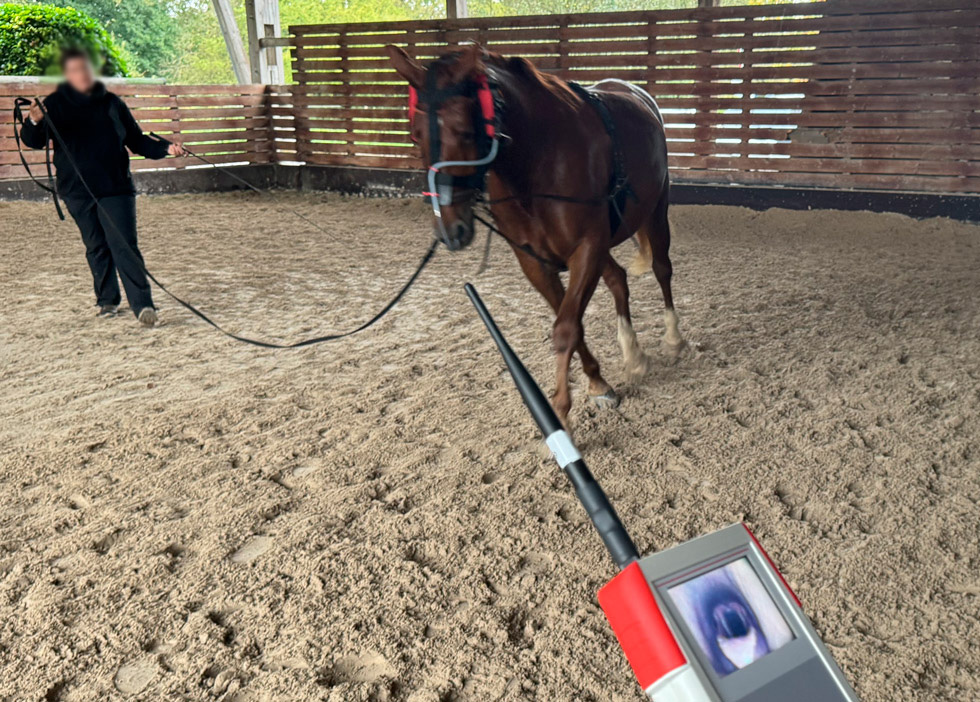
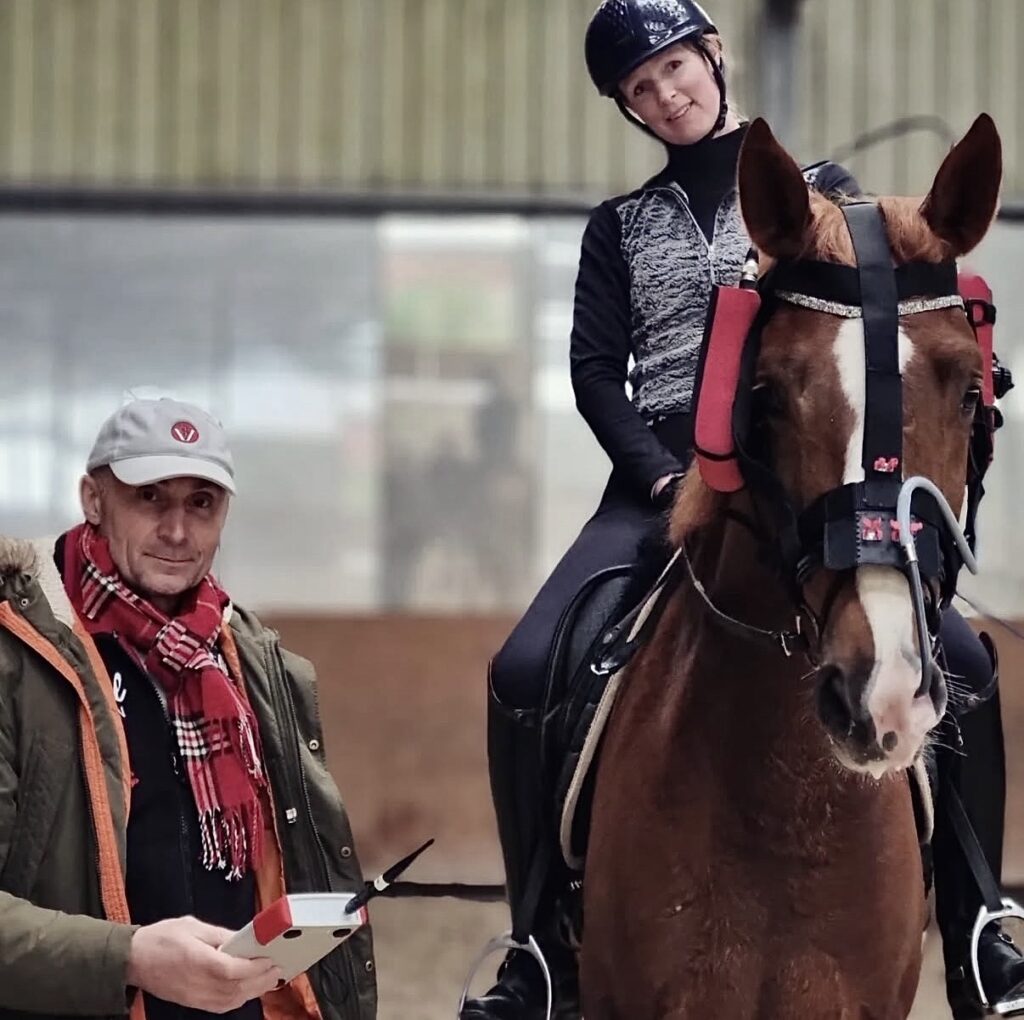
The endoscope is inserted via the nasal passage and securely fixed to the head. All components are positioned exclusively on the head, allowing the horse to be:
- ridden with its usual tack
- worked on the lunge or under saddle
- exercised in the gait in which symptoms occur
During movement, the larynx and pharynx are displayed and recorded in real time.
What is evaluated?
Particular attention is paid to:
- laryngeal movement
- stability of the soft palate
- dynamic changes within the pharynx
- exercise-related airway collapse
Even subtle abnormalities can later be analysed in slow motion under resting conditions.
Evaluation and medical report
Following the examination, a detailed analysis of the recorded video material is performed. You will receive:
- a clear medical assessment
- a structured written report
- representative video excerpts
- the option of a personal case discussion
This provides a transparent, well-founded basis for further decision-making.
What happens next?
Not every abnormality requires treatment. Depending on the findings, appropriate options may include:
- training or management adjustments
- conservative treatment
- further diagnostic investigations
- surgical therapy where indicated
Above all, overground endoscopy provides clarity as to whether – and what – treatment is truly necessary.
When is overground endoscopy recommended?
Typical indications include:
- respiratory noise during riding
- performance decline despite unchanged training
- reduced stamina
- problems in canter or under higher workload
- symptoms occurring only during exercise
- normal findings at rest
The examination is particularly valuable when:
- resting endoscopy shows no clear diagnosis
- previous treatments have not resulted in improvement
- performance issues develop suddenly or progressively
Which horses benefit from this examination?
- leisure and sport horses of all disciplines
- young horses in early training
- competition horses with performance demands
- Thoroughbreds and Standardbreds
Regardless of whether the problem is acute or slowly progressive.
Medical expertise – from a single source
Overground endoscopy is a highly specialised diagnostic procedure.
Its true value depends on correct interpretation and clinical experience.
At VIDOCQ-ESC, examinations are performed by a veterinarian specialised in upper airway surgery in horses.
Not every finding requires treatment.
Not every abnormality requires surgery.
The objective is always:
- medically sound decisions
- individual recommendations
- avoidance of unnecessary procedures
Seamless transition if further treatment is required
If a condition requiring therapy is identified, further management can be planned precisely.
Through close cooperation with selected equine referral clinics, timely continuation of treatment is possible when indicated.
Diagnostics, interpretation and – where necessary – surgical therapy are therefore provided within a coherent medical framework.
Modern airway diagnostics where the problem actually occurs
Many respiratory and performance problems remain undiagnosed because they appear only during exercise.
Overground endoscopy closes the diagnostic gap between:
- unremarkable findings at rest
- and clinically relevant symptoms during training
It replaces assumptions with objective findings and provides security for both horse and owner.
Request an appointment
Not sure whether this examination is appropriate for your horse?
We will be pleased to advise you personally.
Direct contact – without detours
Operating throughout Germany
In cases of unexplained respiratory noise or reduced performance, we also offer mobile overground endoscopy under exercise conditions using state-of-the-art high-end technology.
For specialized surgical procedures, we are also available—by prior arrangement—at an equine clinic near you.
Our Philosophy
VIDOCQ-ESC stands for:
- Close collaboration with horse owners
- Individual care for every patient
- Collegial cooperation
- Medically appropriate diagnostics
- Fair and transparent pricing
You ask,
we answer
Frequently Asked Questions –
Overground Endoscopy
in Horses
No. Overground endoscopy is not painful.
The endoscope used is very thin (approx. 8 mm diameter) and is carefully inserted through the nasal passage.
Some horses may initially perceive a mild tickling or unfamiliar sensation, comparable to a foreign-body feeling in the nose.
Once positioned correctly, the endoscope causes no discomfort.
The entire system is mounted exclusively on the head using a specialised halter and weighs just over one kilogram, making it suitable even for young horses and smaller breeds.
Some horses may initially snort or shake their head slightly.
Once exercise begins, most horses adapt very quickly.
In most cases, no.
For realistic evaluation of airway function, the horse must move naturally and without pharmacological influence. Sedation during the exercise phase is therefore avoided whenever possible.
In rare cases – such as very young or nervous horses – light sedation may be used solely for placement of the endoscope.
This sedation is:
- low-dose
- short-acting
- well controllable
Sufficient time is allowed for full recovery before the exercise examination begins.
The duration depends on when clinical signs occur.
Some horses show abnormalities early during work, others only with increasing workload or fatigue.
In general, the horse is exercised until:
- symptoms are clearly visible
- no further dynamic changes are expected
Including preparation, examination and discussion, the procedure usually takes approximately one hour.
No. Overground endoscopy is safe and non-invasive.
The endoscope is inserted approximately 35–40 cm into the nasal passage and rests securely within the pharyngeal region. There is no risk to the horse.
The only potential risk concerns the sensitive equipment itself, for example if a horse attempts to rub its nose. For this reason, careful handling and a safe environment are ensured throughout the procedure.
The examination is very gentle for the horse.
No – absolutely not.
Overground endoscopy is a diagnostic tool, not an automatic indication for surgery.
Surgical treatment is recommended only if:
- a clearly defined disorder is diagnosed
- and surgery represents the scientifically accepted therapy of choice
In many cases, the following are sufficient:
- training modification
- management optimisation
- follow-up monitoring
All decisions are made individually, based on sound medical reasoning and transparency.
In principle, all horses in which problems occur only during exercise.
The examination is particularly useful in horses with:
- respiratory noise under workload
- performance loss during training
- symptoms occurring only when ridden
- normal findings at rest
- unclear causes despite previous diagnostics
In short:
If a problem occurs in motion, it should be examined in motion.